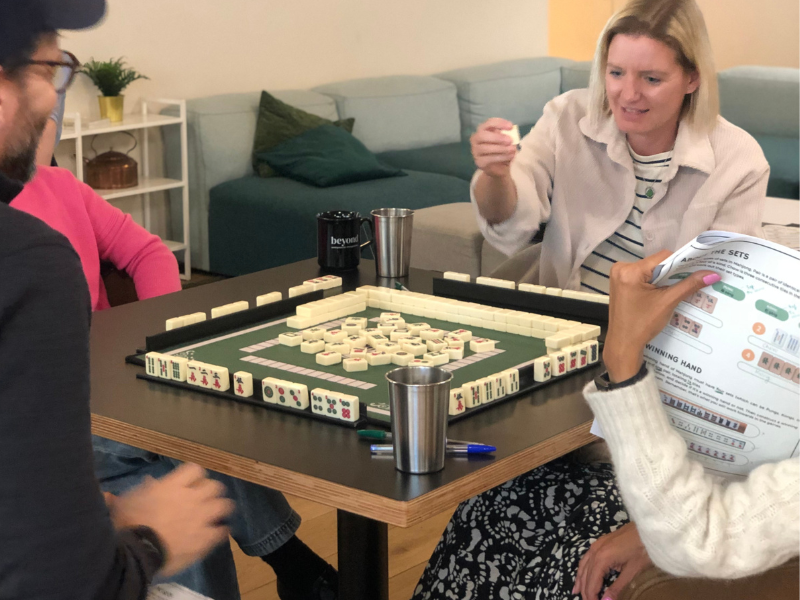
If you’ve ever sat down to a game of Mahjong, you’ll know the satisfying click of the tiles, the quiet tension of waiting for the perfect draw, and the joy (or heartbreak) of finally declaring “Mahjong.” But here’s something that often surprises beginners: not all Mahjong is the same.
Just like how languages has many accents or cuisines have countless regional styles, Mahjong has evolved into several versions across the world like the two of the most talked styles, Chinese Mahjong and American Mahjong or some might call American Mah Jongg.
At first glance, learning to play one version of Mahjong might suggest that you can easily transition to another. However, the differences between the various versions are quite substantial. Even experienced Mahjong instructors have found it necessary to learn the American version from scratch, often requiring several sessions to fully grasp its nuances.
So, how are Chinese and American Mahjong actually different? And if you’re thinking of learning, which version should you start with? Let’s take a closer look.
A Tale of Two Mahjong Traditions
Mahjong originated in China in the 19th century, a tile-based game combining strategy, skill, and a little luck. It spread across Asia rapidly with Japan, Hong Kong, Taiwan, and Korea each adapting their own styles.
When Mahjong arrived in the United States in the 1920s, it sparked a cultural craze. Although American players embraced the game, they felt the need to introduce new twists, particularly regarding score counting. The exact history is unclear, but without modern communication methods and readily available online resources, players likely struggled to consult anyone about special hands and scoring disputes. Ultimately, this led to the formation of the National Mah Jongg League (NMJL), an association dedicated to establishing American-style rules infused with fresh ideas.
In essence:
- Chinese Mahjong is the classic version of the game, where the objective is to achieve a winning hand consisting of four melds and a pair, or to form special hands. There are also several regional variations, such as Hong Kong style, Sichuan style, and Taiwanese Mahjong.
- American Mahjong has evolved from meld-based victories to a focus on winning patterns and includes new rules like tile exchanging and the use of jokers. This version is guided by an annual NMJL card, which lists new hands and their corresponding scores for the year.
Key Differences Between Chinese and American Mahjong
Let’s look at the major distinctions that make each version unique.
1. The Tile
One key difference between Chinese and American Mahjong is the number of tiles:
- Chinese Mahjong:
- 144 tiles in total
- Includes:
- 108 suit tiles (Dots, Bamboo, Characters; 1–9, 4 of each)
- 16 Wind tiles (East, South, West, North; 4 of each)
- 12 Dragon tiles (Red, Green, White; 4 of each)
- 8 Bonus tiles (Flowers and Seasons; optional)
- American Mahjong:
- 152 tiles in total
- Includes all Chinese Mahjong tiles plus 8 Jokers
- Jokers can substitute for other tiles in forming official hands according to the National Mah Jongg League rules
This difference affects gameplay significantly: Chinese Mahjong is more flexible and strategic, while American Mahjong is structured and points-focused, with Jokers adding a unique strategic element.
2. The scoring and Hands
In Chinese Mahjong, the goal is simple:
Form a winning hand of four sets and one pair.
The sets can be:
- Pung (three of a kind),
- Chow (three consecutive numbers in the same suit),
- Kong (four of a kind),
plus a pair (two identical tiles).
Once you complete your hand, you declare “Mahjong” and score based on the tiles you used.
Players must choose one of those hands and aim to build it exactly. So your strategy depends not just on the tiles you draw, but also on memorising and interpreting the yearly card.
In American Mahjong, however, things are very different.
There’s no free-form building. Instead, every year the National Mah Jongg League releases an official Card of Hands — a list of around 50–60 specific combinations that are valid for that year only.
What this means:
Chinese Mahjong is about reading the game, adapting your hand, and timing your moves.
American Mahjong is about pattern recognition, memory, and planning based on fixed combinations.
#mahjong_dearasia
We know learning Mahjong on your own is hard—and not very fun. Dear Asia is the Mahjong school you’ve been looking for. Based in London, book tickets for our regular Saturday workshops below or hire our private Mahjong instructors.
3. The Jokers
Jokers are the signature of American Mahjong.
They can replace almost any tile (except single tiles or pairs), making them incredibly powerful. But they also change the rhythm of play because stealing or exchanging Jokers becomes a big part of the strategy.
In Chinese Mahjong, there are no Jokers, and flowers and seasons are often bonus points drawn after certain actions, not tiles you build with.
What this means:
If you enjoy flexibility, surprises, and a touch of luck, you’ll love American Mahjong’s Jokers.
If you prefer clean, strategic play with less randomness, Chinese Mahjong will feel more balanced.
4. The Pace and Style of Play
Chinese Mahjong tends to be faster and more straightforward once you understand the rules. Each round flows quickly so it’s ideal for social games or competitions.
American Mahjong can be slower and more thoughtful, since players spend more time planning hands from the yearly card, tracking Jokers, and strategizing.
What this means:
If you love strategy and quick rounds, Chinese Mahjong is a great start.
If you enjoy a deeper puzzle-solving feel with more structure, try American Mahjong.
5. Culture and Community
One of the most beautiful things about Mahjong is its cultural diversity.
In China, Mahjong is a beloved social tradition played with family, friends, and even in parks or teahouses. It’s fast, friendly, and often filled with laughter and conversation.
In America, Mahjong has become a community game especially among women’s groups, Jewish-American communities, and now younger players rediscovering it as a social hobby. American Mahjong gatherings often have a strong sense of friendship, structure, and ritual.
So… Which Mahjong Should You Learn?
Honestly, there’s no wrong choice.
It depends entirely on what kind of player and learner you are.
| If you prefer… | Then try… |
| Simple, fast gameplay | Chinese Mahjong |
| Classic Asian tradition | Chinese Mahjong |
| Structure, rules, and variety | American Mahjong |
| Using Jokers and special cards | American Mahjong |
| Learning one set of rules for global play | Chinese Mahjong |
Many players learn both. Once you know the fundamentals tile types, sets, and basic flow switching versions becomes easier.
Want to hire us?
London Mahjong Instructors
Our Mahjong instructors are professional teachers who know how to teach anyone to play—quickly, practically, and in a fun, social way. Read our reviews to see how well we do. Book us for your event—we’ve worked with celebrities, film sets, and large corporate functions!
Pro Tip: Start with Chinese Mahjong
If you’re completely new, we usually recommend starting with Chinese Mahjong.
It’s the foundation is simple, intuitive, and universally recognisable across Asia. Once you’ve got the hang of it, moving into American Mahjong (with Jokers and the yearly card) will feel like a fun new challenge rather than an entirely new game.
Learning Mahjong in London
If you’re intrigued by Mahjong and want to experience the traditional game, the best way to start is to learn from experts. Dear Asia London offers Mahjong classes designed for completed beginner and you will learn how to play in just one lesson.
Learning with a professional, hands-on approach ensures that you don’t just memorise the rules but also appreciate the cultural richness and social nuances of the game.
Whether your goal is casual play with friends, participating in social gatherings, or becoming a serious player, starting with a Mahjong lesson gives you a deeper understanding of the roots of this timeless game. And once you master it, exploring variations like American Mahjong and others will feel much easier.
Whether you fall in love with the fluid simplicity of Chinese Mahjong or the structured creativity of American Mahjong, you’re becoming part of a century-old global tradition that connects people one tile at a time. So, shuffle the tiles, listen to that satisfying click, your Mahjong journey starts now.