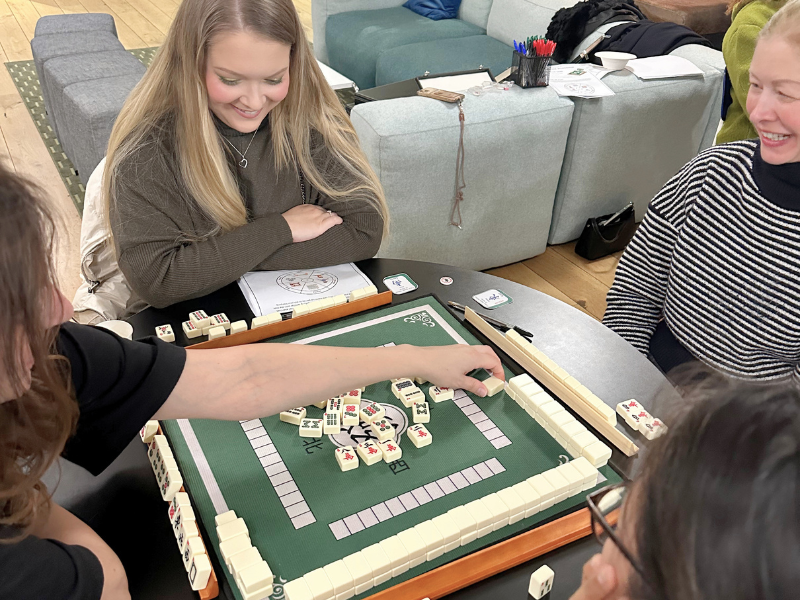
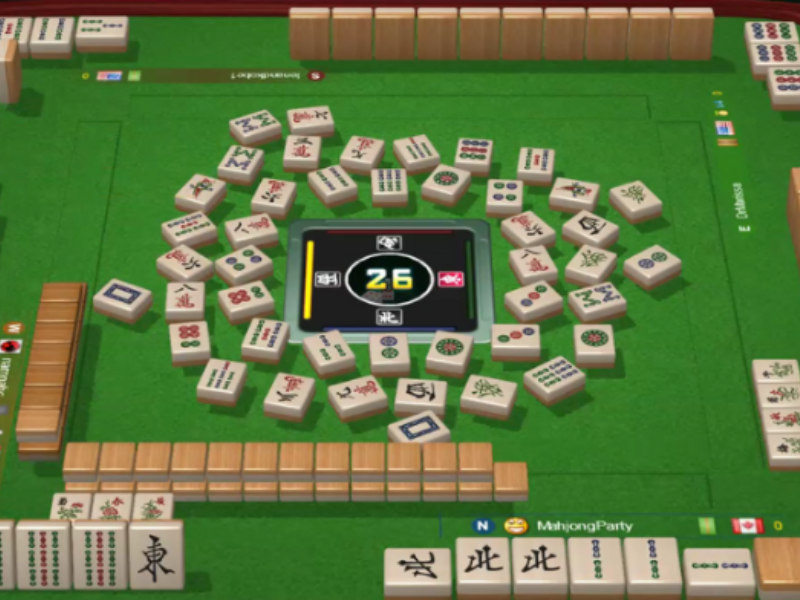
One of the most common questions we get in our workshop is:
“Can I play Mahjong if there are only two of us?”
The answer is: absolutely, yes!
Sometimes, you just don’t have a full table—but the itch to play Mahjong is still there. Maybe it’s a quiet evening at home, or a friend cancels last minute. Whatever the reason, you don’t have to give up the game. With just two people, you can still enjoy a meaningful, strategic version of Mahjong that keeps your skills sharp and the joy of the game alive.
While Mahjong is traditionally a four-player game, the two player mahjong is a wonderfully practical and often overlooked format. It’s surprisingly strategic, efficient, and well-suited for learning, practising, or simply enjoying the game when you’re short of a full table.
We’ll walk you through exactly how to play Mahjong with two players, including setup options, modified rules, scoring methods, and tips to keep it engaging and skill-focused.
# learn mahjong online
Book Our Online Lesson
Struggling to learn Mahjong on your own? Our London-based Mahjong school offers Saturday lessons for beginners. Good news, we also offer online sessions for your convenience. Book your online lesson today and start mastering the game!
Why Try 2-Person Mahjong
There are many good reasons to learn two-player Mahjong, especially if you’re practising or just want to stay connected to the game between club nights.
Benefits of two-player Mahjong:
- More draws, more experience
You’ll see far more tiles and build more hands than in a standard four-player game. It’s ideal for learning combinations and improving speed. - Perfect practice environment
Great for learning yaku (winning patterns), improving tile efficiency, and trying new strategies without the pressure of a full table. - Easy to organise
No need to wait for others. You can play at home, while travelling, or in short study sessions. - Sharpens your judgment
With only one opponent, every discard counts. It’s a good way to build your defensive reading and decision-making.
What You’ll Need
You can use any standard Mahjong set. The key items are:
- A complete Mahjong tile set
- A flat surface or small table
- Two players
Game Setup: Two Players
Here’s a simple guide to setting up a two-player game:
Step 1: Build the Wall or not build the wall
Each player builds a wall in front of themselves—just as in a four-player game. You can use the full length (18 tiles × 2 rows), or shorten it to 12×2 or even 9×2 if you want faster games. The two other sides of the square are left empty. However, you can also not build any walls, just leave the tiles facing down in the center of the table. You can then just draw from the pile.
Step 2: Dealing
Decide who will be East (dealer) by rolling dice or taking turns.
- East draws 14 tiles for Hand East (1), then draw 13 tiles for Hand West (3).
- West draws 13 tiles for Hand South (2), then draw 13 tiles for Hand North (4).
- East discards one tile to begin. The game continues to South, West, North.
So basically each person would be playing two hands. The first person plays hand 1 and 3, the second person plays hand 2 and 4, make sure to remember whose term is it next.
Adjusted Rules for Two-Player Play
With only two players, a few simple rule adjustments keep the game flowing fairly and strategically.
Discard Claims
- Pong and Kong: Either player can call for a Pong or exposed Kong from the other’s discard, just as in four-player Mahjong.
- Chow:
- Option 1: Only the next player in turn can claim a Chow (closest to traditional rules).
- Option 2: Allow either player to Chow. This creates a faster, more open game. Choose what feels right for you and agree before starting.
Kongs and Bonus Draws
If a player calls an exposed Kong, they draw a replacement tile from the end of the wall (or the pile), just like in normal play. Concealed Kongs work the same way.
If you’re using flower or season tiles (common in Hong Kong), draw a replacement tile immediately after drawing one, as usual. 👉 However, for more smooth game play, we would suggest to remove flowers and seasons in a Two person game.
Winds and Seats
For simplicity, most two-player games skip the concept of prevailing winds and player winds. However, if you’re using scoring systems where winds matter (such Chinese Classical), you can assign seats manually or rotate dealer every round.
Optional Rule Variations
To keep things engaging, feel free to explore some additional variations. These are particularly helpful for study sessions or short game formats.
Use a Simplified Tile Set
Some players remove Winds, Flowers, and Dragons for a faster, numbers-only version of Mahjong. This sharpens suit reading and improves tile efficiency.
Visible or Hidden Discards
For beginners, keeping all discards visible helps improve memory and pattern recognition. Advanced players can make things more challenging by turning discards face-down or using a smaller discard pool.
Set a Target Challenge
Use 2-player games to work on specific goals:
- Only win with pure suits (Qing Yi Se)
- Practise concealed hands only
- Aim to reach ready hands (tenpai) within 10 turns
- Track how quickly you can form a valid hand
These kinds of challenges are especially useful if you’re studying for tournaments or exams like MCR grading.
Scoring Options for Two Players
Depending on how casual or serious you want your session to be, here are three easy ways to score:
1. Win-Based Scoring
Keep it simple: the player with the most winning hands after a set number of rounds or time wins. No calculations necessary.
2. Chips or Points
Use chips, coins, or tally marks. For example:
- Each win = 1 point or chip
- A self-drawn win = 2 points
- A limit hand = 5 points
You can play to a target (e.g., first to 10) or use it for casual tracking.
3. Use Real Scoring Tables
If you’re practising a specific style (Hong Kong Old Style, MCR, or Riichi), use the official scoring rules and fan tables. This is best for intermediate to advanced students preparing for real games.
Strategic Considerations in Two-Player Mahjong
The game dynamics are slightly different when only two people are playing, and that means strategy shifts in interesting ways.
- Defensive play is harder: With only one opponent, it’s easier to read your discards—and harder to hide your hand.
- Every call matters: Claiming a Pong or Chow becomes riskier because your opponent is watching every move.
- Speed matters: You’ll draw and discard more quickly, so shape recognition and hand efficiency become essential.
- Less randomness: You’re seeing 50% of all draws. Tile tracking and discard logic are stronger factors than luck.
If you want to improve fast, review each hand together. Ask: “At what point could I have changed direction?” or “What was the giveaway in my discards?”
Two-player Mahjong may not be as widely known or formally codified, but it offers real benefits. It’s a perfect training tool for learners and a fun, low-pressure way to enjoy the game without waiting for four players. Whether you’re practising your new found mahjong skills, or just having a relaxed game at home, two-player Mahjong helps keep your skills sharp and your passion alive.
We encourage students to use 2-player Mahjong between classes to review concepts, explore new strategies, and build confidence. It’s also an excellent stepping stone for new players before joining a full table.
Struggling to Find Players? Join just play mahjong club!
We know that one of the biggest challenges for many players—especially here in the UK—is simply finding enough people for a full Mahjong table. Friends are busy, schedules don’t always line up, and sometimes you’re just left with the tiles and no one to play with. That’s exactly why we created our “Just Play” Mahjong tables at Dear Asia Mahjong. No need to organise a group or wait for a full house—just turn up, take a seat, and enjoy a proper game with friendly players who are just as eager to play as you are.
#mahjong_dearasia
London Mahjong School
Join Dear Asia, London’s vibrant Mahjong school! Attend our fun Saturday workshops or hire a private instructor to host exciting Mahjong events at home or work. Let’s make your next gathering unforgettable!