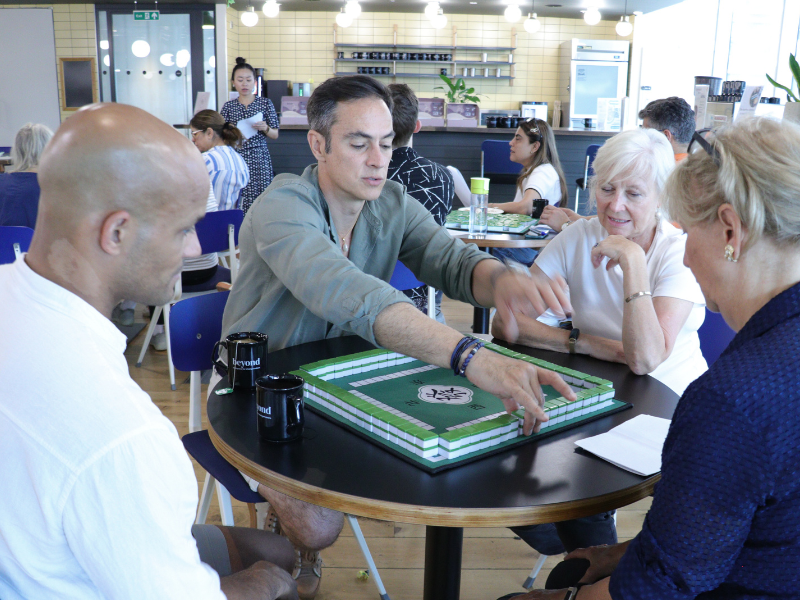
When most people think of mahjong, they picture four players around a square table, drawing and discarding tiles in a lively battle of skill and luck. But in many parts of Southeast Asia especially Malaysia, Singapore, and parts of Thailand and Vietnam – a popular variation cuts the number of players down to three. This 3-player version keeps the game fast, intense, and perfect for smaller groups.
Finding fellow 3-person mahjong players in London can be a real challenge — the game is popular in Southeast Asia, but not as widely played here. Whether you’re short on players or curious about regional twists, here’s your complete guide to 3-person mahjong.
What Makes 3 Players Mahjong Different?
The core gameplay — forming sets of tiles and a winning hand — remains the same, but there are some notable differences:
- Number of Players: As the name suggests, only three players participate.
- Fewer Tiles: The 3-player version usually removes one full suit from the game (often the bamboo/bams or the characters), reducing the tile pool.
- Faster Pace: With fewer tiles in circulation and fewer opponents, games move quicker and hands complete more often.
- Different Table Setup: Since one side of the table will be “empty,” the dealer position and wall-building change slightly.
These tweaks create a game that’s more dynamic and can be played even when you can’t find a fourth player.
# learn mahjong online
Book Our Online Lesson
Struggling to learn Mahjong on your own? Our London-based Mahjong school offers Saturday lessons for beginners. Good news, we also offer online sessions for your convenience. Book your online lesson today and start mastering the game!
Tile Set for 3-Person Mahjong
You’ll still use a standard 144-tile mahjong set, but with modifications. The exact tiles removed can vary by region, but the most common setup in Southeast Asia is:
- Remove 2–8 of one suit (e.g., all bamboo suit tiles except 1 and 9) or in some rules remove the entire bamboo suit.
- Flowers and seasons are optional — some groups use them, others don’t.
Why remove tiles?
With only three players, if you keep all the tiles, it becomes harder to complete sets since the fourth copy of each tile might be “dead” (unavailable due to the missing player’s wall). Removing a suit or part of it keeps balance and makes the game flow faster.
Building the Wall
In 4-player mahjong, each player builds a wall of 18 stacks of two tiles (36 tiles wide). In 3-player mahjong, you’ll build three walls:
- Each wall is 18 stacks of two tiles as usual.
- Arrange the three walls in a U-shape, leaving the fourth side open.
The dealer is still determined by dice throw, but rotations move between the three players instead of four.
Dealing the Tiles
Dealing is similar to the 4-player version, but since there are fewer walls, the dealer’s dice throw will determine the breaking point in one of the three walls. Each player starts with 13 tiles (except the dealer who starts with 14).
The dealer throws the dice, breaks the wall, and the tiles are dealt in blocks of four to each player until everyone has their starting hand.
Basic Rules & Hand Structure
The objective remains the same: complete a winning hand of four sets (pungs, chows, or kongs) and one pair.
- Pung: Three identical tiles
- Chow: Three consecutive tiles in the same suit (can only be made with your own draws or from the discard of the player to your left)
- Kong: Four identical tiles (declare and draw a replacement tile)
- Pair: Two identical tiles
Gameplay Flow
- Draw & Discard — On your turn, draw a tile from the wall or take a discard (if it completes a pung, chow, or kong). Then discard one tile.
- Claiming Discards:
- For pungs or kongs, any player can claim the discard.
- For chows, only the next player in turn order can claim.
- Declaring a Win: If a tile completes your hand, you can declare mahjong immediately.
The game moves clockwise, with each player aiming to complete their hand before the others.
Special Rules in Southeast Asian 3-Player Mahjong
- No Winds tiles: some groups might remove the four wind tiles (East, South, West, North) entirely to make the game even faster.
- Scoring Variations: Scoring tends to be more flexible and often simplified compared to official Chinese scoring. In some groups, only specific hands get higher scores, while others use a flat-rate win system.
- Flowers and Seasons: If used, drawing a flower or season earns bonus points and allows you to draw a replacement tile immediately.
Why People Love 3-Player Mahjong
- Faster Games: Perfect for casual evenings or short sessions.
- Easier to Organize: You only need two friends instead of three.
- Higher Win Frequency: More winning hands per hour keeps everyone engaged.
Tips for Winning
- Adjust Your Strategy for Fewer Tiles: With fewer suits, it’s easier to predict which tiles are in play — use this to your advantage.
- Watch Discards Closely: With only three players, you’ll see tiles circulate faster; pay close attention to avoid giving away winning tiles.
- Push Early: Don’t wait too long to commit to a hand shape; faster games reward decisive play.
3-person mahjong might not be as globally famous as the standard four-player version, but it’s a vibrant part of Southeast Asian mahjong culture. Whether you’re playing in a café in Penang, a family home in Singapore, or just with friends on a rainy evening, it’s an exciting, fast-paced way to enjoy the game — and you don’t need a full table to get started.
Alternatively you can have a ghost player
If you’re comfortable with Cantonese Mahjong and don’t want to learn the rules for Southeast Asian 3‑player variants, you can still play with three people using a “ghost” player. Build all four walls as usual; one seat is the ghost. A person (or volunteer) manages the ghost hand by drawing and discarding tiles face‑down without looking. The ghost cannot chow, pung, kong, or win—its tiles remain face‑down on the table—while the other three players play the regular game in normal turn order. This method is a common solution at our Just Play sessions, and its more popular than using the new rules above.
Join our just play table
Although playing 3-person mahjong is possible, there’s nothing quite like the full experience of a standard 4-player game. The strategy, the interaction, and the excitement all reach a whole new level when you have a full table. But we get it — finding three other players in London can be tough. That’s why we created the Just Play Mahjong Club at Dear Asia where you can join others who know the game but struggle to gather a full group. It’s a great way to keep playing and stay connected with fellow mahjong lovers, even when a full table isn’t available.
#mahjong_dearasia
London Mahjong School
Join Dear Asia, London’s vibrant Mahjong school! Attend our fun Saturday workshops or hire a private instructor to host exciting Mahjong events at home or work. Let’s make your next gathering unforgettable!